

The $3.4 Trillion Wake-Up Call
Here’s something that should make every C-suite leader pause.
According to the International Data Corporation (IDC) Worldwide Digital Transformation Spending Guide, global spending on digital transformation is projected to hit $3.4 trillion in 2026.
And yet, study after study shows that fewer than 35% of transformation initiatives actually deliver the lasting business impact they were funded to create.
This is where choosing the right digital transformation partner becomes one of the most consequential decisions a leadership team can make.
Because here is the uncomfortable truth.
A transformation initiative rarely fails because a company lacks ambition. More often, it fails because nobody stopped to ask the hard questions early enough:
- Are we solving the right business problem?
- Are we modernizing systems or actually changing outcomes?
- Does our partner own business results or simply project delivery?
- What happens after go-live?
These questions matter even more in 2026.
AI has moved from experimentation to operations. Cloud environments are becoming increasingly complex. CFOs want proof of ROI, not vague three-year promises. Boards expect measurable progress, faster execution, and fewer expensive detours.
In this environment, selecting a digital transformation consulting partner is not a procurement exercise. It is a strategic decision that directly influences execution speed, employee adoption, customer experience, and long-term competitiveness.
This guide is built to help leaders make that decision with more clarity and confidence.
You will learn:
- The real difference between a vendor and a true transformation partner
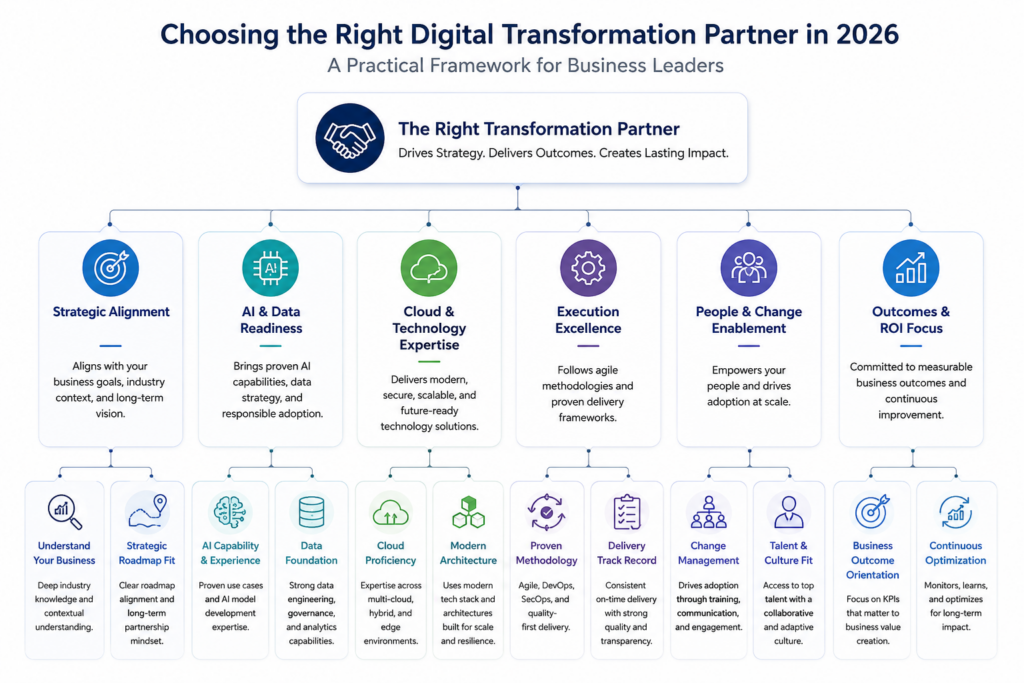
- The important criteria for choosing a digital transformation partner
- Common red flags that derail transformation programs
- How to choose a digital transformation partner using a practical evaluation framework
- Questions to ask before signing a contract
- How to choose a cloud consulting partner for digital transformation
- Key criteria for selecting AI partner for digital transformation
What Is a Digital Transformation Partner and Why Do So Many Companies Get It Wrong?
Let us start with something surprisingly simple.
Many organizations think they are hiring a transformation partner when they are actually hiring an implementer.
That distinction matters more than most teams realize.
A true digital transformation partner works alongside your business to redesign how you operate, deliver value, and scale growth through technology, process improvement, data, and organizational change.
That sounds straightforward.
In reality, companies often confuse three very different players.
1. The Vendor
A vendor sells technology.
That might be software licenses, cloud platforms, analytics systems, automation tools, or enterprise applications.
Their responsibility typically ends at the adoption of their product.
They are valuable, but they are not accountable for business transformation.
2. The Systems Integrator
A systems integrator helps execute.
They implement software, migrate systems, manage technical configurations, and deliver projects against a defined scope.
If your requirements are already clear and success is narrowly technical, this can work well.
But there is a catch.
Most systems integrators optimize for delivery.
Transformation demands outcome ownership.
A technically successful implementation can still fail if employees do not adopt it, processes remain broken, or business KPIs never improve.
3. The Digital Transformation Consulting Partner
This is where things change.
A strong digital transformation consulting partner combines business strategy, technology execution, and measurable accountability into one model.
Why This Distinction Matters Before You Even Write an RFP
Many organizations begin partner selection by asking:
“Who can do the work?”
A better question is:
“What kind of accountability are we buying?”
If you need technical execution, an implementation partner may be enough.
If you need someone who can guide strategy, delivery, adoption, and measurable business improvement, you are asking how to partner for end-to-end digital transformation, and that requires a very different evaluation lens.
Define Your Transformation Goals Before Evaluating Anyone
Here is where many companies quietly make their biggest mistake.
They begin evaluating partners before defining success.
A budget gets approved.
An RFP goes out.
Partners pitch.
Presentations happen.
Meanwhile, internally, leadership teams are still debating what the transformation is actually supposed to achieve.
That creates confusion from day one.
The reality is simple:
Vague goals attract vague proposals.
Clear goals attract strong partners.
Before choosing any digital transformation partner, leadership teams should align around four areas.
Customer Experience
What friction exists in the customer journey today?
Are customers waiting too long, abandoning purchases, escalating complaints, or struggling with fragmented experiences?
Transformation tied to customer outcomes often produces the fastest business impact.
Operational Efficiency
Where is time being wasted?
Manual approvals, repetitive processes, disconnected systems, duplicated reporting, and fragmented workflows. These inefficiencies compound quietly until they become expensive.
This is where digital transformation scale agile solutions often create measurable gains.
Instead of saying:
“We want to become more efficient.”
Say:
“We want to reduce onboarding time from 10 days to 48 hours.”
Specificity matters.
Revenue Growth
Is transformation helping defend revenue or unlock new opportunities?
Leaders should ask:
- Are we creating new digital products?
- Improving conversion rates?
- Accelerating sales cycles?
- Expanding customer lifetime value?
Strong partners connect transformation to measurable business outcomes.
Weak ones stay trapped in technical conversations.
Workforce Readiness
Transformation affects people.
Always.
Yet workforce adoption is still one of the most underfunded parts of enterprise transformation.
Ask:
- What skills will teams need?
- What workflows will change?
- What resistance should we expect?
- What training is required?
This becomes particularly important when evaluating the criteria for selecting AI partner for digital transformation, because AI adoption is rarely just technical. It is behavioral.
Many organizations underestimate this reality. Successful AI adoption is not simply about deploying tools. It involves governance, workforce enablement, operational readiness, and measurable business outcomes. If AI is becoming part of your roadmap, explore how AIT approaches enterprise AI and machine learning transformation.
A Quick Leadership Checklist Before Partner Evaluation
Before meeting any provider, ask:
- What business outcome are we funding?
- What does success look like in 12 to 18 months?
- What internal friction points hurt us most today?
- Do we need implementation help or how to partner for end-to-end digital transformation?
- How mature is our internal change management capability?
- Who owns executive sponsorship?
These answers dramatically improve partner evaluation quality.
The Important Criteria for Choosing a Digital Transformation Partner
Now we get to the heart of the decision.
The reality is that partner selection is rarely about finding the cheapest option or the most polished presentation.
It is about reducing execution risk.
Below are the first criteria leaders should evaluate.
- End-to-End Transformation Capability
- Industry-Specific Experience
- AI Readiness and Real-World Capability
- Cloud Architecture and Scalability Maturity
- Agile Delivery at Enterprise Scale
Red Flags That Should Make You Pause
Sometimes the fastest way to choose the right partner is learning how to reject the wrong one.
Here are the warning signs leaders consistently overlook.
They Talk About Tools Before Business Problems
If discovery immediately becomes a product demo, something is off.
Strong partners spend time understanding:
- Business friction
- Revenue pressure
- Customer experience gaps
- Internal inefficiencies
- Workforce challenges
Technology comes later.
Transformation begins with business problems.
Senior Experts Sell. Junior Teams Deliver.
This happens constantly.
The polished leadership team disappears after contract signing.
Meanwhile, delivery gets delegated to inexperienced resources.
Ask to meet your day-to-day team before signing.
Not afterward.
Case Studies Show Outputs, Not Outcomes
Be cautious of statements like:
- Platform deployed
- Migration completed
- Integration finished
Those are outputs.
Ask instead:
- What changed?
- What improved?
- What business impact occurred?
They Cannot Talk Honestly About Failure
Ask: Tell me about a transformation that did not go as planned.
Experienced firms answer honestly.
Immature firms avoid the question.
That tells you everything.
10 Questions to Ask Before You Sign With Any Partner
If you only remember one section from this guide, make it this one.
When evaluating how to choose digital transformation partner options, ask:
- What does failure look like in an engagement, and how have you handled it?
- How do you measure transformation success after go-live?
- Who exactly will be on our account from day one?
- How do you approach enterprise AI readiness?
- What cloud capabilities and partnerships do you maintain?
- How do you scale delivery across large programs?
- What does change management look like in practice?
- How do you structure accountability around business outcomes?
- How do you maintain continuity if team members leave?
- What should our first 90 days realistically look like?
Simple questions.
Powerful answers.
Or revealing non-answers.
FAQ: Quick Answers Leaders Need Before Choosing a Partner
What is a digital transformation partner?
A digital transformation partner is an organization that helps businesses modernize operations, improve customer experience, integrate technology, and drive measurable business outcomes through a mix of strategy, implementation, process improvement, and organizational change.
Unlike a traditional vendor, a transformation partner supports long-term adoption and business impact, not simply technical deployment.
What are the important criteria for choosing a digital transformation partner?
The most important criteria include:
- End-to-end delivery capability
- Industry-specific expertise
- AI readiness and governance maturity
- Cloud architecture capability
- Enterprise agile delivery experience
- Change management and workforce adoption expertise
- Commercial accountability
- Team continuity and staffing maturity
Strong partner evaluations focus on measurable business outcomes, not technical promises.
How to choose a digital transformation partner?
To understand how to choose a digital transformation partner, start by clarifying internal goals before speaking to providers.
Ask:
- What business problem are we solving?
- What outcomes matter most?
- What timeline is realistic?
- How much internal capability exists?
Then evaluate providers against structured criteria, referenceable outcomes, change management maturity, and long-term accountability.
How to choose digital transformation partner options for a mid-sized business?
Mid-sized organizations should prioritize practicality over scale theater.
Large presentations and big logos can feel reassuring, but what matters is execution fit.
When evaluating how to choose digital transformation partner candidates, prioritize:
- Relevant industry experience
- Flexible engagement models
- Clear ROI expectations
- Post-launch support
- Workforce enablement
The best partner is often not the biggest one. It is the one most aligned with business realities.
How to choose a cloud consulting partner for digital transformation?
Choosing cloud expertise is no longer simply about migration.
Leaders evaluating how to choose a cloud consulting partner for digital transformation should assess:
- Multi-cloud architecture expertise
- FinOps maturity
- Compliance readiness
- Security integration
- AI infrastructure preparedness
- Cloud cost optimization track record
A strong partner helps reduce complexity, improve resilience, and future-proof transformation decisions.
What are the criteria for selecting AI partner for digital transformation?
The modern criteria for selecting AI partner for digital transformation should include:
- Proven production deployment experience
- AI governance frameworks
- Security and compliance readiness
- Workforce adoption methodology
- ROI measurement capability
- Model monitoring and observability
A provider that only discusses tools is not necessarily an AI transformation partner.
The strongest partners connect AI investments to operational and business outcomes.
The Decision Is Bigger Than Technology
Let us be honest for a moment.
Choosing the wrong partner does not just waste budget.
It slows momentum.
It frustrates teams.
It weakens trust in leadership.
It delays opportunities that competitors may already be capturing.
And in a market increasingly shaped by AI, cloud modernization, automation, and operational speed, lost time becomes expensive quickly.
But the opposite is true too.
The right digital transformation partner can accelerate execution, improve confidence, reduce risk, and help teams adopt meaningful change faster.
More importantly, they leave the business stronger than they found it.
That is what a good transformation should feel like.
Not chaos.
Not confusion.
Not endless steering committee meetings with no measurable progress.
Just clarity, momentum, and outcomes that matter.
At AIT, we believe transformation should feel practical, measurable, and deeply connected to business goals.
Our teams bring strategy, cloud modernization, AI readiness, change management, and delivery execution together under one accountability model, helping organizations move from fragmented initiatives to meaningful business outcomes.
Whether you are evaluating providers for the first time or reassessing a transformation already underway, we are happy to help you pressure-test the path forward.
Ready to Evaluate Your Transformation Strategy?
Book a Free Transformation Readiness Assessment
In a focused 30-minute session, our senior transformation specialists will help you:
- Clarify business priorities
- Identify transformation gaps
- Evaluate partner-readiness criteria
- Prioritize execution opportunities
- Determine whether AIT is the right fit for your goals


 Palantir Consulting Services: How Enterprises Can Maximize the Value of Foundry
  Top Enterprise AI Agents Use Cases Transforming Businesses in 2026
  AI Implementation Challenges & How to Solve Them
  How to Choose the Right Digital Transformation Partner in 2026: A Practical Guide for Business Leaders
  Tech Trends 2026: From Experimentation to AI Enterprise Advantage