
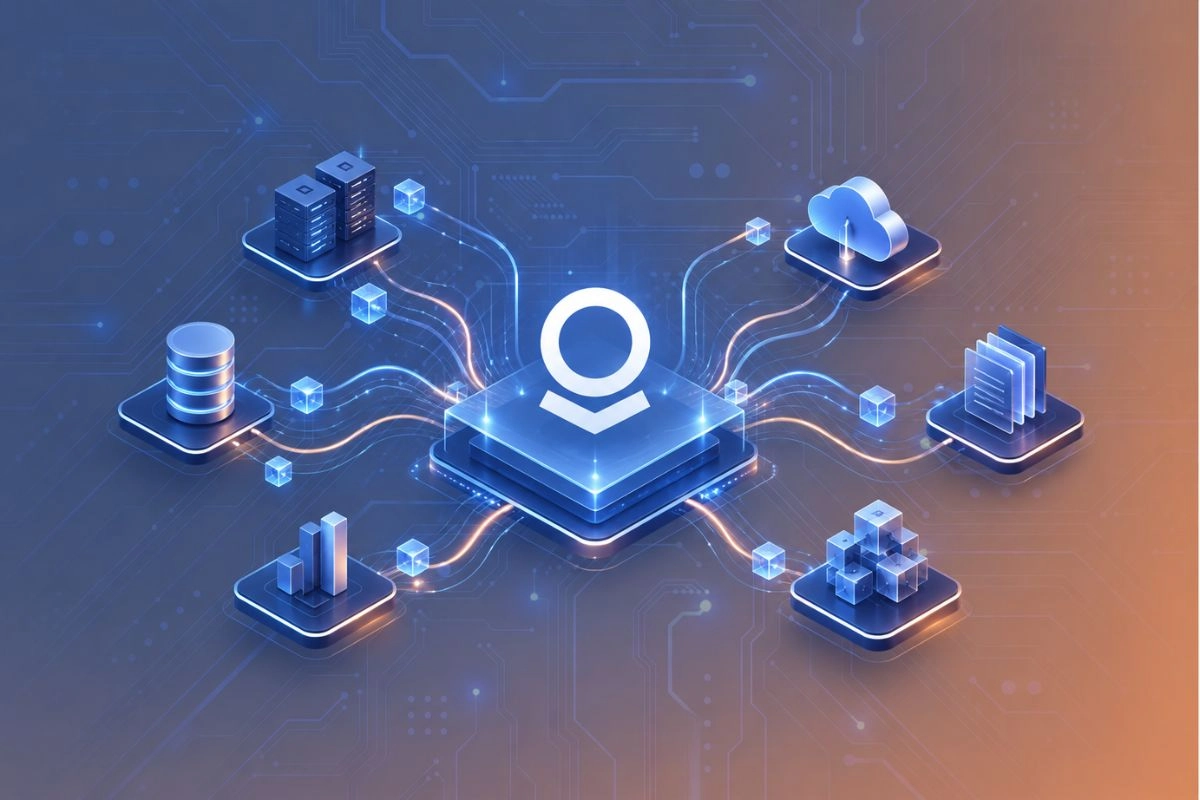
You already have more enterprise data than your teams can realistically work with. The challenge is getting that data to work together when your business needs it most.
Maybe you’re trying to connect operational data with customer information, bring multiple systems into a unified workflow, or turn complex data into an application your teams can actually use. This is where Palantir Foundry can change the conversation, but getting the most from the platform often requires more than technology alone.
Palantir consulting services can help bridge that gap by connecting Foundry capabilities with your existing systems, data environment, workflows, and business priorities.
And there’s a reason the foundation matters. Gartner found that organizations reporting successful AI initiatives invest up to four times more, as a percentage of revenue, in foundational areas such as data quality, governance, AI-ready people, and change management than organizations experiencing poor AI outcomes.
For enterprises evaluating Foundry, that makes the implementation approach just as important as the platform itself.
Why Palantir Foundry Is More Than Another Data Platform
When you evaluate Foundry, it’s easy to focus on individual capabilities such as data integration, pipelines, analytics, applications, or AI and machine learning. The bigger opportunity, however, comes from connecting these capabilities so they support the way your enterprise actually operates.
Palantir describes Foundry as a data operations platform that provides capabilities across data integration, transformation, analytics, applications, security, governance, and more. The value isn’t necessarily in using every capability at once. It’s in creating a connected environment around the business problems you need to solve.
Consider a manufacturing organization. Your ERP contains inventory information, your production systems capture what’s happening on the floor, your maintenance platform tracks equipment, and your CRM contains customer demand. Each system may work perfectly well on its own, but the business often needs answers that require information from several of them at the same time.
Suppose a production machine begins showing signs of failure. Your operations team doesn’t only need to know that the machine is at risk. They may also need to understand which production schedules could be affected, whether replacement parts are available, which customer orders could be delayed, and whether maintenance can be scheduled without creating another operational problem.
That’s where connecting enterprise data becomes much more valuable than simply storing it.
How Palantir Foundry Services Connect Enterprise Data
Your data rarely sits neatly in one system. It can be distributed across databases, cloud platforms, enterprise applications, data warehouses, APIs, files, and streaming sources, with each environment using different structures and update cycles.
Palantir Foundry provides connectivity capabilities across different enterprise data sources and supports approaches including batch, streaming, and change data capture. This can help enterprises bring relevant information together without requiring every existing system to be replaced.
But integration is only the beginning. You still need to decide which data sources matter for a particular use case, how the information should be transformed, how frequently it needs to be updated, and how access and governance should be managed.
That is where Palantir Foundry services become more than a technology exercise. The implementation needs to reflect how your organization actually uses data.
Turning Connected Data Into Usable Foundry Solutions
Connecting data doesn’t automatically create business value. Once information is available, you need reliable pipelines, appropriate transformations, data quality processes, lineage, and applications or workflows that allow people to act on the information.
This is where Palantir Foundry implementation becomes important. Foundry provides capabilities for data transformation, pipeline management, data quality, lineage, and production data workflows. Your implementation approach determines how those capabilities are applied to your specific environment.
Think back to the manufacturing example. Instead of asking different teams for separate reports on production, inventory, maintenance, and customer demand, an operations team could work from an application that brings the relevant information together.
The difference isn’t simply that the data is now in one place. It’s that the data has become usable in the context of an actual business decision.
Where Palantir Foundry Consulting Adds Value
Buying Foundry is one decision. Making it work across a complex enterprise is another.
You still need to determine which systems should be connected first, which use cases deserve priority, how Foundry fits into your existing architecture, and how successful implementations can be scaled beyond the initial project. Those decisions can have a significant impact on how quickly the organization starts seeing value from the platform.
This is where Palantir Foundry consulting can help. A structured consulting approach can typically include the following stages:
1. Assess the existing environment
Start by understanding your current systems, data landscape, integrations, workflows, business requirements, and technical constraints. This provides the context needed to determine where Foundry can create the most value.
2. Prioritize business use cases
Instead of attempting to connect every available data source, identify the business problems where Foundry can deliver measurable value. This keeps implementation focused and gives teams a clear reason for each integration.
3. Design the implementation
Define the required integrations, pipelines, data workflows, applications, security controls, and governance requirements. The objective is to create an architecture that can support both the immediate use case and future expansion.
4. Build and integrate
Connect the required source systems, develop pipelines, configure the Foundry environment, and build the applications or workflows needed by business users.
5. Operationalize and scale
Once a use case has been validated, move it into production and establish reusable patterns that can support additional departments, workflows, and use cases.
The objective isn’t to implement Foundry simply because you have the platform. The objective is to make Foundry useful to your business.
Using Foundry to Modernize Enterprise Data Workflows
Enterprise data modernization doesn’t always mean replacing the systems you’ve spent years building.
Your ERP can continue serving as your ERP. Your CRM can continue managing customer relationships, and your operational systems can continue supporting day-to-day processes. The opportunity is to connect the information those systems generate so it can be used more effectively across the organization.
Foundry provides capabilities for working with structured, unstructured, and semi-structured data, along with transformation, pipeline management, lineage, and security capabilities. That makes it relevant for organizations looking to advance enterprise data modernization without treating modernization as a technology replacement exercise.
A practical approach is to start with a specific business requirement, identify the data behind it, connect the relevant sources, and then expand the foundation as additional use cases emerge.
From Foundry Implementation to AI and Operational Intelligence
Once your data is connected, governed, and available through the right workflows, you can build more than reporting applications.
The same foundation can support analytics, machine learning, AI applications, automation, and operational decision-making. Palantir’s documentation describes Foundry as supporting analytical and machine learning workflows while connecting with broader AI and operational capabilities across its platform.
This is where an effective data architecture for AI becomes useful. You aren’t creating a separate data environment every time a new AI initiative appears. Instead, you’re building on a foundation that can support multiple business use cases as your requirements evolve.
For the manufacturing organization we started with, that could mean moving from equipment monitoring to predictive maintenance, supply chain intelligence, production optimization, or AI-assisted operational decisions without rebuilding the entire data foundation each time.
When Should You Consider Palantir Foundry Services?
You may want to consider Foundry when your organization is dealing with multiple disconnected data sources, complex legacy environments, repeated manual data preparation, slow decision cycles, or AI and analytics initiatives that struggle to access reliable enterprise information.
It can also be relevant when different business teams need to work with the same information but currently rely on separate reports, spreadsheets, or disconnected applications. In these situations, the question isn’t necessarily whether you need another technology platform. It may be whether you need a better way to connect the systems and data you already have.
Getting More Value From Your Palantir Foundry Investment
Foundry gives you the platform capabilities. The real value comes from applying them to the problems that matter to your organization.
That means selecting the right use cases, connecting the right data sources, designing practical workflows, building applications around real user needs, and creating an implementation roadmap that can scale as your Foundry environment grows.
At AIT Global, our Palantir Foundry services support Foundry implementation and integration, data modeling, pipelines and workflow automation, custom applications, AI/ML integration, and ongoing support.
If you’re evaluating Foundry, planning an implementation, or looking to expand an existing environment, talk to AIT Global’s Palantir Foundry experts about your requirements.


 Palantir Consulting Services: How Enterprises Can Maximize the Value of Foundry
  Top Enterprise AI Agents Use Cases Transforming Businesses in 2026
  AI Implementation Challenges & How to Solve Them
  How to Choose the Right Digital Transformation Partner in 2026: A Practical Guide for Business Leaders
  Tech Trends 2026: From Experimentation to AI Enterprise Advantage