
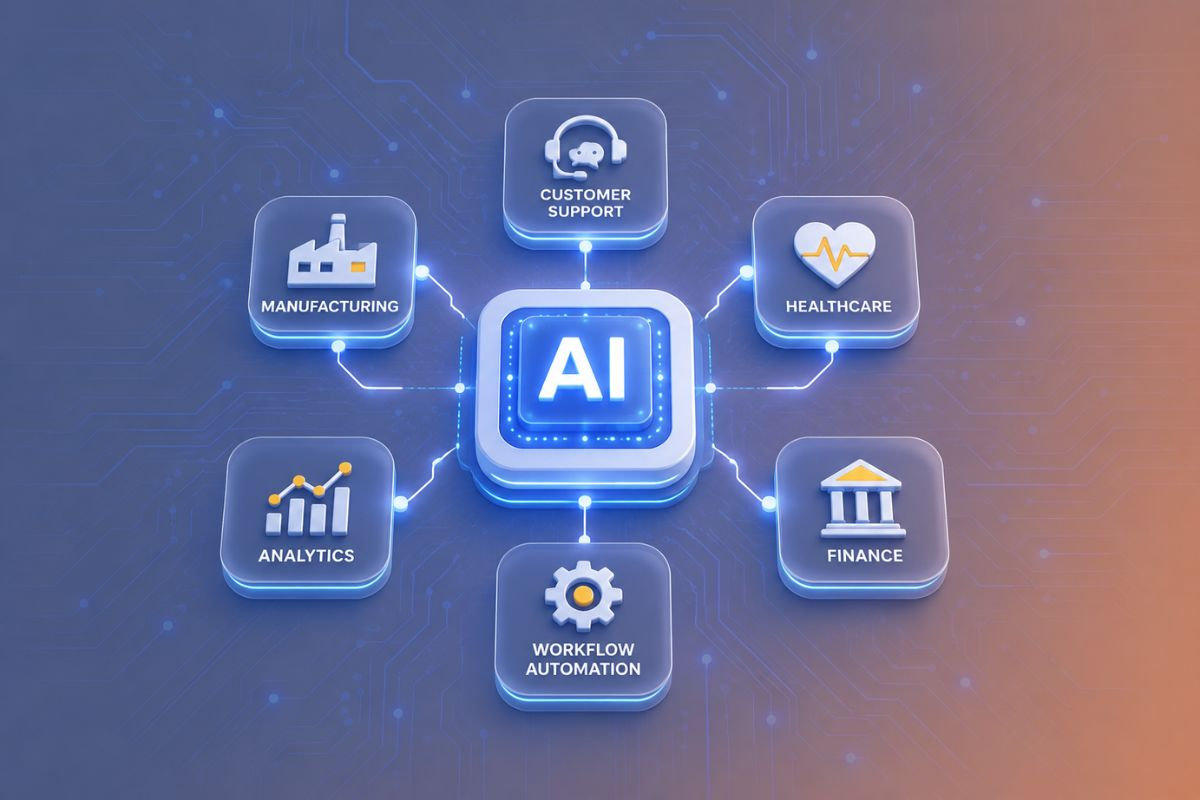
Every Monday morning, thousands of employees across large enterprises begin their day the same way. They update spreadsheets, approve purchase requests, search for documents, respond to repetitive emails, and switch between multiple business applications just to complete a single task. These activities keep the business running, but they rarely move it forward.
Now imagine if most of that routine work happened automatically.
Not because another employee worked overtime, but because intelligent software understood the objective, coordinated the process, and completed the work with minimal human intervention.
That’s exactly why enterprise AI agents have become one of the biggest enterprise technology trends in 2026.
For years, enterprises invested in automation to eliminate repetitive tasks. Then generative AI helped employees create content, summarize reports, and answer questions faster. Today, the conversation has shifted again. Organizations are looking beyond AI that simply assists people and toward AI that can execute work across business systems.
The numbers reflect that shift.
Gartner predicts that by 2028, 15% of day-to-day work decisions will be made autonomously through agentic AI, compared with virtually none in 2024. That signals a major transformation in how enterprises will operate over the next few years.
The question is no longer whether AI belongs in the enterprise.
The real question is where it can create the greatest business impact.
In this guide, we’ll explore how enterprise AI agents are transforming industries, the business problems they solve, and why forward-thinking organizations are making them a core part of their digital transformation strategy.
What Are Enterprise AI Agents?
One of the biggest misconceptions in today’s AI conversation is that every intelligent tool is an AI agent.
It isn’t.
An AI assistant waits for instructions.
An AI agent works toward a goal.
For example, an AI assistant can help draft a customer email. An AI agent can retrieve customer information from the CRM, verify order details, prepare a response, create a support ticket, notify the warehouse if a replacement is required, and automatically update internal systems.
The difference isn’t intelligence.
It’s execution.
That’s why AI agents in business are becoming far more valuable than standalone AI assistants. Instead of helping employees complete individual tasks, they help organizations complete entire workflows.
| Capability | Traditional Automation |
AI Assistant |
Enterprise AI Agent |
|---|---|---|---|
|
Follows predefined rules |
✓ |
– |
✓ |
|
Generates content |
– |
✓ |
✓ |
|
Connects business systems |
Limited |
Limited |
✓ |
|
Executes multi-step workflows |
– |
– |
✓ |
|
Requires constant human prompts |
✓ |
✓ |
Minimal |
Think of it this way.
Traditional automation follows rules.
AI assistants answer questions.
Enterprise AI agents take ownership of a business objective and coordinate the work needed to achieve it.
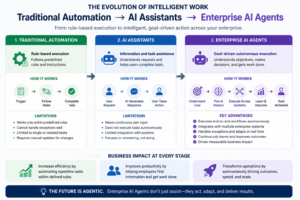
Want to understand the technology behind enterprise AI agents? Explore our comprehensive guide to Agentic AI and discover how autonomous reasoning, planning, and workflow orchestration are transforming modern enterprises.
Read: What Is Agentic AI?
Why Enterprises Are Investing in AI Agents
Most organizations aren’t adopting AI because it’s new.
They’re adopting it because the way work gets done is changing.
Customers expect immediate responses. Employees expect smarter digital tools. Leadership teams want faster decisions without increasing operational costs.
Traditional automation helped reduce repetitive work, but modern business processes span multiple applications, teams, and approvals. That’s where enterprise AI automation makes a real difference.
Instead of automating isolated tasks, AI agents orchestrate complete workflows across CRM, ERP, HR, finance, and customer service platforms. They reduce delays, eliminate manual handoffs, and surface insights when they matter most.
According to Microsoft’s Work Trend Index, employees increasingly want AI to handle repetitive administrative work so they can focus on strategic and creative responsibilities.
That shift benefits everyone.
Employees spend less time on routine tasks.
Customers receive faster service.
Business leaders gain more efficient operations.
Technology finally works the way people always expected it to.
1. Customer Service. Faster Responses, Better Experiences
Customer expectations have changed.
People no longer compare your support experience with your competitors.
They compare it with the fastest digital experience they’ve ever had.
That makes speed and consistency critical.
This is why customer service has become one of the fastest-growing AI agent use cases.
Modern AI agents don’t simply answer FAQs. They understand customer intent, retrieve account information, recommend solutions, initiate workflows, and escalate only the conversations that require human judgment.
Imagine a telecommunications company receiving thousands of support requests every day.
Instead of routing every request through multiple departments, an AI agent verifies customer information, checks service history, identifies the issue, schedules technician visits when required, and updates the CRM automatically.
Customers receive quicker resolutions.
Support teams focus on complex cases rather than repetitive requests.
Businesses improve service quality while reducing operational costs.
That’s the real value of AI workflow automation. It doesn’t replace human interaction. It ensures people spend their time where it matters most.
2. Manufacturing. Predicting Problems Before They Become Disruptions
Manufacturers have no shortage of data.
The challenge is turning that data into timely decisions.
Every production line generates information about equipment performance, inventory levels, supplier deliveries, and product quality. Waiting until a problem appears often means higher costs and unexpected downtime.
This is where AI agent applications are making a measurable difference.
AI agents continuously monitor operational data, identify unusual patterns, and recommend actions before disruptions occur. They can also optimize production schedules, improve inventory planning, coordinate supplier communications, and support quality inspections.
Imagine a manufacturer preparing for a large production run.
An AI agent detects that a critical shipment has been delayed. Before managers even notice the issue, it identifies alternative suppliers, evaluates delivery timelines, adjusts production schedules, and alerts stakeholders.
Instead of reacting to problems, the business stays ahead of them.
That’s the difference between using data to report yesterday’s performance and using AI to shape tomorrow’s decisions.
3. Healthcare. More Time for Patients, Less Time on Paperwork
Healthcare has always been about people.
Yet doctors, nurses, and administrative staff spend a significant portion of their day managing appointments, updating records, verifying insurance, processing claims, and coordinating follow-ups. These tasks are necessary, but they often reduce the time available for what matters most. Patient care.
This is why healthcare organizations are rapidly adopting AI agents for enterprises to simplify administrative workflows while keeping clinicians in control of critical decisions.
Instead of acting as another software tool, AI agents become digital coordinators. They can schedule appointments, send reminders, verify insurance eligibility, assist with medical documentation, trigger prior authorization workflows, and notify patients about follow-ups without requiring staff to manually manage every step.
Consider a busy hospital where a patient cancels a specialist appointment at short notice.
Rather than leaving the slot unused, an AI agent identifies another patient on the waiting list, confirms availability, updates the physician’s schedule, and sends notifications automatically. What could have taken multiple phone calls and several staff members now happens in minutes.
The result isn’t just operational efficiency.
Patients receive faster access to care, healthcare professionals spend less time on administrative work, and hospitals make better use of limited resources.
AI doesn’t replace clinical expertise. It creates more opportunities for healthcare professionals to use it.
4. Financial Services. Smarter Decisions Without Increasing Risk
Speed has become a competitive advantage in financial services.
Customers expect instant loan approvals, seamless digital banking experiences, and quick insurance claims. At the same time, financial institutions must meet strict compliance requirements and continuously monitor for fraud.
Balancing speed with accuracy has never been easy.
This is where AI workflow automation is proving its value.
Instead of manually reviewing documents and switching between multiple systems, AI agents can gather customer information, validate records, identify missing documentation, perform preliminary risk assessments, and prepare recommendations for human reviewers.
Imagine a commercial bank processing hundreds of business loan applications every day.
An AI agent collects financial statements, checks regulatory requirements, compares historical lending data, flags potential risks, and prepares a structured summary for the loan officer. The final approval still belongs to the human expert, but the decision-making process becomes significantly faster and more informed.
Beyond lending, financial institutions are also using AI agents for fraud detection, compliance reporting, Know Your Customer (KYC) verification, and customer onboarding.
According to IBM’s Cost of a Data Breach Report, organizations that extensively deploy AI and automation experience lower breach costs and faster incident response. While the report focuses on cybersecurity, it highlights a broader reality. Intelligent automation is becoming an essential part of enterprise resilience.
For financial organizations, AI isn’t just improving efficiency. It’s helping build greater trust.
A Practical Framework for Adopting Enterprise AI Agents
One of the biggest misconceptions about AI is that organizations need to automate everything at once.
In reality, the most successful enterprises take a much more focused approach.
They start with one business problem, measure the outcome, and scale from there.
If you’re planning to implement enterprise AI automation, these four principles can help you get started.
Start With a High-Impact Workflow
Look for processes that are repetitive, time-consuming, and involve multiple manual handoffs.
Customer support, procurement, IT service management, document processing, and finance operations are often excellent starting points because improvements are easy to measure.
Build on Clean, Connected Data
AI is only as effective as the information it can access.
Before deploying AI agents, ensure your core business systems are connected and your data is accurate, secure, and well governed.
Connected data powers connected AI. See how our Data Modernization Services help enterprises eliminate data silos, improve governance, and accelerate AI-driven transformation.
Keep Humans in the Loop
AI agents should support decision-making, not replace accountability.
Routine execution can be automated, but strategic decisions, regulatory approvals, and customer-sensitive situations should always involve human oversight
Measure Business Outcomes
Don’t measure success by the number of AI agents you’ve deployed.
Measure improvements that matter to the business.
- Faster response times.
- Lower operational costs.
- Higher employee productivity.
- Reduced processing times.
- Improved customer satisfaction.
These are the metrics that demonstrate real return on investment.
The Future of Enterprise AI Agents
Enterprise AI is entering a new phase.
While many organizations have successfully deployed AI for individual use cases, the next wave of innovation is focused on connecting those capabilities across the business.
Today, AI agents commonly automate specific workflows, such as resolving customer queries, processing invoices, or assisting IT teams. Increasingly, however, enterprises are adopting multi-agent systems, where specialized AI agents collaborate across departments to complete end-to-end business processes.
Imagine a customer placing an order online. One AI agent verifies payment, another checks inventory, a third schedules shipping, while another updates the customer with delivery information. Instead of isolated automation, multiple AI agents work together to deliver a seamless business outcome.
As AI models become more capable and enterprise platforms continue to evolve, organizations will move from task automation to intelligent workflow orchestration. The businesses that begin building these capabilities today will be better positioned to improve efficiency, adapt faster, and scale AI responsibly.
Conclusion
The conversation around AI has moved beyond experimentation.
Today’s business leaders aren’t looking for another chatbot or productivity tool. They’re looking for practical ways to improve efficiency, reduce costs, and create better customer and employee experiences.
That’s exactly where enterprise AI agents deliver value.
Whether it’s helping manufacturers prevent downtime, enabling healthcare teams to spend more time with patients, improving customer support, or accelerating financial decision-making, AI agents are transforming how work gets done across industries.
The organizations that gain the greatest advantage won’t be the ones adopting AI simply because it’s trending.
They’ll be the ones applying AI to solve real business challenges, measuring the results, and scaling with purpose.
In the end, AI isn’t the differentiator. The way you apply it is.
Ready to Build Smarter Enterprise Workflows?
Implementing AI isn’t about replacing people. It’s about empowering them with intelligent systems that remove repetitive work, accelerate decision-making, and improve business outcomes.
At AIT Global, we help organizations identify high-value AI agent use cases, integrate AI seamlessly with existing enterprise systems, and build scalable solutions that deliver measurable results.
Whether you’re beginning your AI journey or looking to scale existing initiatives, our experts can help you turn strategy into execution.
Schedule a Consultation with Our AI Experts
Frequently Asked Questions
What are enterprise AI agents?
Enterprise AI agents are intelligent software systems that can understand business objectives, interact with enterprise applications, and execute multi-step workflows with minimal human intervention.
How are AI agents different from AI assistants?
AI assistants respond to prompts and generate information. AI agents go further by planning tasks, connecting with enterprise systems, and completing workflows to achieve a specific business goal.
Which industries benefit the most from AI agents?
Customer service, manufacturing, healthcare, financial services, retail, logistics, and IT are among the industries seeing significant improvements through AI agents in business.
How should organizations begin implementing AI agents?
Start with a single, high-impact business process, ensure your data is well governed, define measurable success metrics, and scale gradually once you demonstrate value.


 Top Enterprise AI Agents Use Cases Transforming Businesses in 2026
  AI Implementation Challenges & How to Solve Them
  How to Choose the Right Digital Transformation Partner in 2026: A Practical Guide for Business Leaders
  Tech Trends 2026: From Experimentation to AI Enterprise Advantage
  What is XBRL: Learn the Definition, its Benefits, and Trends